4 Min Read • July 27, 2026
From Gen Z to Boomers: The Biggest Roadblocks to EV-Only Households
The transition to an EV future has been anything but steady for the automotive industry but consumer adoption and loyalty have remained on an upward trajectory. In our third and most recent study of EV owners, even more say they’ll buy another EV, moving from 82% to 90%.
But this year, another interesting stat increased. One in 10 (11%) of EV owners say they’ll always keep a gas-powered car alongside their EV. This might seem low but is up from 0% in our previous study. So what's preventing these existing EV owners from becoming EV-only households?
Very few (just 1%) see themselves returning to driving exclusively gasoline-powered vehicles. Instead, many are choosing to own both.
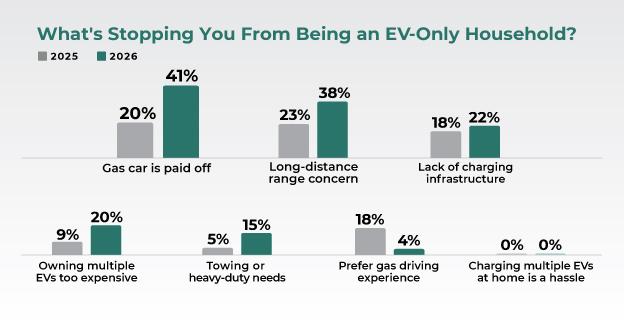
Year over year, three obstacles to EV exclusivity stand out:
- Owning a fully paid-off gasoline vehicle
- Concerns about EV range during long-distance travel
- Availability of charging infrastructure
More revealing is how these concerns differ by generation.
Gen Z and Younger Millennial Buyers Are Ready To Commit
Generation Z (ages 18-30) and young millennials (ages 31-36) report the fewest obstacles to becoming EV-only households:
- Only one-third cite the lack of a car payment as a reason to keep a gas vehicle around, compared with nearly half of older owners.
- Just 19% point to charger availability as a barrier, making them the least concerned about charging infrastructure.
- Range during long-distance travel remains the top concern, with 41% of young millennials and 38% of Gen Z worried about EV range on road trips.
Younger owners primarily focus on long-distance travel and range anxiety concerns, which appear to be viewed as manageable inconveniences rather than deal-breakers. They're generally more comfortable incorporating charging stops into their travel routines since they grew up with smartphones, navigation apps and digital planning tools. For dealerships, these customers are less likely to need convincing that an EV fits their lifestyle. Instead, they benefit from education around trip planning, charging apps and maximizing vehicle range.
Old Millennials Balance Practicality and Affordability
Old millennials (ages 37-46) represent something of a transition generation. Their concerns are spread across several factors rather than concentrated around one dominant issue.
Thirty-seven percent continue to cite range limitations for long trips, while 21% remain concerned about charging infrastructure. They’re also among the most likely to say owning multiple EVs is simply outside their budget, which suggests affordability remains a meaningful consideration even for current EV owners.
Unlike older generations, however, they're less emotionally or financially tied to keeping an existing gas vehicle. While 42% still report a paid-off gas car as a barrier, many appear willing to transition fully when the economics make sense.
Generation X and Baby Boomers Are Loyal to Gas
Nearly half of boomers (62 and older) and more than four in 10 of Gen X (ages 47-61) respondents say their fully paid-off gas car is the primary reason they haven't become an EV-only household.
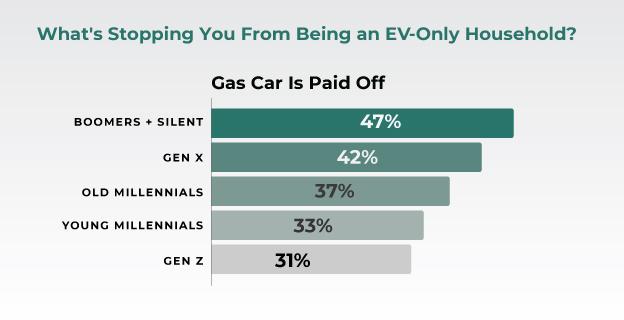
In fact, this concern has grown significantly over time.
- Forty-seven percent of boomers cite a fully paid-off gas vehicle as the main reason they haven’t gone all electric. And 42% of Gen X respondents say the same.
- Across all respondents, those who identified a paid-off gas vehicle as their biggest obstacle increased from 16% in 2023 to 20% in 2024 and jumped to 41% in 2026.
The reasoning is understandable. A vehicle with no monthly payment feels like a low-cost insurance policy against uncertainty. Owners see little reason to sell a dependable vehicle that's already paid for, particularly if it serves as a backup for road trips or unexpected situations.
Range anxiety also remains significantly higher among older generations.
- Thirty-eight percent of Gen X continue to identify long-distance travel as a concern.
- Thirty-eight percent of boomers identify long-distance travel as a concern.
- Charging infrastructure worries remain elevated at 26% and 18%, respectively.
The qualitative feedback reinforces the data. Several respondents described living in areas with limited public chargers, making them reluctant to rely exclusively on an EV. Others pointed to longer vacations, rural destinations and national parks where charging options remain inconsistent. Even owners who regularly drive their EVs explained they still choose their gas vehicle for trips exceeding 100 miles simply because they have greater confidence in the fueling experience.
What This Means for Dealerships
The data suggests dealerships should focus less on selling EVs and more on selling confidence.
For many customers, particularly Gen X and boomers, the obstacle isn't dissatisfaction with their EV. It's uncertainty about giving up the security of an already-paid-for gas vehicle.
That creates an opportunity for dealers to reshape the ownership conversation. Trade-in programs that focus on EV owners around loyalty and conquest are beginning to pop up. Reiterate the cost-saving they’ve already witnessed with their existing EV to illustrate how adding another EV will help offset the advantage of keeping a "free and clear" gas car.
Education also remains critical even with these customers who understand the advantages of owning an EV. They may not need additional charging stations but perhaps an upgrade is in order as technology is always advancing.
Share This