8 Min Read • July 1, 2026
Dealership Software Guide: Systems, Features and How To Choose the Right Platform
Key Takeaways
- Dealerships typically rely on multiple software systems to manage Sales, Service, Inventory, Finance and customer relationships.
- One out of two dealers use between two to three systems to complete their job, making integration and data sharing a critical part of software selection.
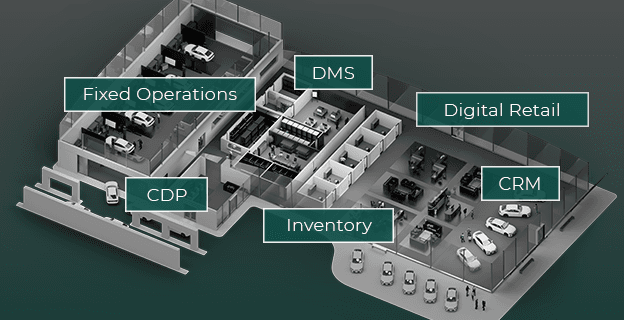
- The Dealer Management System (DMS) serves as the operational foundation, while Customer Relationship Management (CRM), digital retail, Fixed Operations, inventory and analytics platforms support specialized functions.
- Successful software strategies prioritize efficiency, reporting and a connected customer experience across departments.
- The best dealership software is a combination of systems that aligns with your dealership's workflows, growth plans and long-term business goals.
Auto dealer software has become increasingly complex as the automotive retail industry evolves. Most dealerships no longer rely on a single system. Instead, they use a combination of platforms to manage Sales, Service, Inventory, Finance and the customer experience across every stage of the life cycle. In fact, data from CDK's 2026 Friction Points Study reflects this shift: One out of two dealers use between two to three systems to complete their job, making integration, data visibility and workflow efficiency increasingly important when evaluating dealership software.
At its core, dealership software refers to the ecosystem of tools that support daily operations and long-term growth. This includes DMS, CRM platforms, inventory and merchandising tools, Fixed Operations solutions, and data and analytics platforms that connect everything together.
Rather than evaluating these systems in isolation, dealerships are typically making decisions about how these tools will work together. The goal isn’t just to add technology but to create a connected environment that improves efficiency, reduces manual work, and provides clear visibility across the business.
How To Define the Right Type of Dealership Software
Why Dealerships Evaluate Multiple Systems
Most dealerships aren’t evaluating a single tool. They’re comparing combinations of systems that must:
- Support daily operations
- Connect customer and vehicle data
- Improve efficiency across departments
- Scale with the business
The right approach starts with identifying which types of software are needed.
How Dealer Management Systems Fit Into Dealership Software
At the center of most dealership software environments is the DMS. The DMS serves as the system of record for the dealership, supporting core operational functions such as Accounting, deal management, Service Repair Orders, and compliance.
Because it manages critical business data, the DMS typically acts as the foundation that other systems connect to. CRM platforms, digital retail tools, inventory systems, and Fixed Ops solutions all rely on the DMS to access consistent, accurate information across departments.
It’s essential to understand the role of the DMS when evaluating dealership software. It shapes how data flows between systems, how processes are structured, and how easily teams can access the information they need to do their jobs effectively.
For a more detailed look at how a DMS works, key features to evaluate, and how to compare providers, see our DMS guide. A DMS typically supports:
- Accounting and financial reporting
- Sales and F&I workflows
- Service ROs
- Compliance and documentation
What To Consider When Evaluating a DMS
- How well does it support dealership-specific Accounting requirements?
- Can it scale across multiple rooftops or brands?
- How flexible is reporting and data access?
- How easily does it connect with CRM, inventory and digital retail tools?
How CRM, Digital Retail, Fixed Ops, Inventory and Data Platforms Differ
CRM Systems
Most dealerships use a CRM platform that’s built specifically for the automotive retail industry. Automotive CRMs focus on managing customer relationships, including:
- Lead tracking
- Follow-up workflows
- Ongoing communication
What To Consider
- Does it centralize leads from all sources?
- Is follow-up automated and consistent?
- Will your team adopt and use it daily?
Digital Retail and Website Platforms
Digital retail tools support the online buying experience through:
- Vehicle search and merchandising
- Trade-in workflows
- Online deal structuring
What To Consider
- Can customers complete meaningful steps online?
- Does it connect to inventory and pricing data in real time?
- Does it integrate with financing and F&I tools?
Fixed Ops Solutions
Fixed operations software focuses on Service, Parts and warranty workflows, which are a major driver of dealership profitability. These tools are often evaluated separately from Sales systems because they support:
- Service scheduling and RO workflows
- Technician productivity and workflow management
- Multipoint inspections and recommendations
- Customer communication and real-time Service updates
- Parts inventory and fulfillment
- Warranty claims and compliance processes
What To Consider
- How efficiently does it support Service Lane workflows?
- Does it improve Technician productivity and utilization?
- Can it provide real-time updates to customers?
- Does it integrate with DMS and Parts systems?
- How well does it support warranty processes and reporting?
Inventory Management Tools
Vehicle inventory solutions are often evaluated for their ability to balance profitability and turnover.
Capabilities include:
- Pricing optimization
- Demand forecasting
- Vehicle merchandising
- Syndication across channels
What To Consider
- How does it determine pricing recommendations?
- Can it forecast demand and identify aging inventory?
- Does it integrate with your DMS and website?
Customer Data and Analytics Platforms
Customer Data Platform (CDP) and dealership reporting and analytics solutions help unify data and support decision-making. They’re often used to:
- Create a single view of the customer
- Enable targeted marketing
- Track performance and ROI
What To Consider
- Can it connect data across Sales, Service and Parts?
- Does it support segmentation and personalization?
- How accessible and actionable is the reporting?
What Software Do Most Car Dealerships Use?
Most dealerships use a combination of systems rather than a single platform. A common setup includes:
- A DMS as the operational core
- A CRM for customer engagement
- Digital retail and website tools
- Inventory management systems
- Additional solutions for Service, analytics or Finance
The exact mix depends on dealership size, number of locations, operational complexity and business focus.
How Dealerships Decide Between Multiple Systems vs. an Integrated Platform
In many cases, dealerships manage these capabilities across multiple vendors, which can require significant effort to integrate data and maintain consistent workflows.
As a result, some dealerships choose to standardize on a more integrated approach. Platforms like CDK are designed to bring together core systems — including dealer management, customer relationship management, digital retail, inventory and analytics — within a connected ecosystem.
Rather than stitching together separate tools, this approach can allow dealerships to:
- Share data more consistently across departments
- Reduce duplicate entry and manual processes
- Gain unified visibility into performance and customer activity
- Support both Variable and Fixed Ops within a single platform
For dealerships with multiple locations or more complex workflows, evaluating whether to adopt an integrated platform versus a mix of point solutions is often a key part of the decision process.
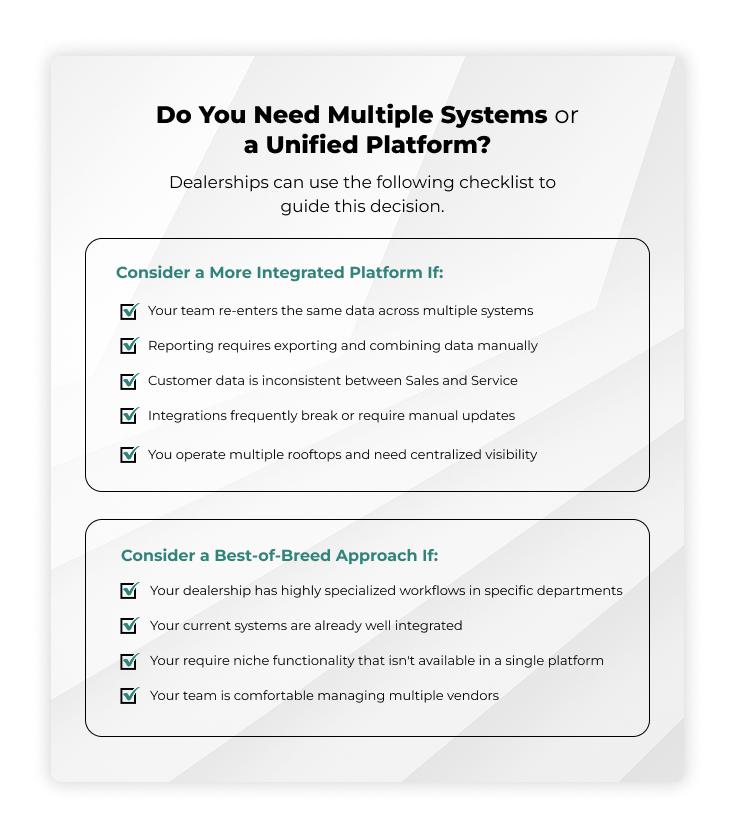
Checklist: Do You Need Multiple Systems or a Unified Platform?
Dealerships can use the following checklist to guide this decision.
Considering an Integrated Platform?
See how CDK helps dealerships connect DMS, CRM, Digital Retail, Fixed Operations, inventory and analytics within a single ecosystem.
Features That Matter Most When Comparing Software
How To Prioritize Features by Department
Not every feature carries equal value. Dealerships typically evaluate features based on how they impact:
- Sales workflows
- Service operations
- Parts and inventory
- Accounting and reporting
- Customer experience
A useful approach is to group features into:
- Essential operational requirements
- Efficiency improvements
- Role-specific tools
Core Features That Affect Efficiency
Across departments, key features include:
- Real-time inventory visibility
- Desking and deal structuring tools
- Accounting and financial reporting
- Workflow automation and task routing
- Mobile access for staff
- Real-time updates across systems
In Fixed Ops, additional capabilities matter:
- Service Advisor workflow tools
- Technician productivity tracking
- Digital inspections and recommendations
- Customer communication tools
Reporting, Analytics and Data Visibility
Access to data is a major factor in software evaluation. Dealerships compare platforms based on:
- Availability of real-time reporting
- Ability to track performance across departments
- Flexibility in building custom reports
- Visibility into key metrics such as Sales, Service revenue and inventory turnover
More advanced platforms also support:
- Forecasting
- Trend analysis
- Attribution and ROI tracking
Many dealerships also evaluate how platforms support more advanced capabilities, such as predictive insights, automated decisioning and personalized communication. These features are increasingly important as dealerships look to use data more proactively across Sales and Service.
How To Evaluate Data, Integrations and Ecosystem Fit
No system operates in isolation. Dealerships must evaluate how platforms work together across the business.
Key Considerations When Evaluating Your Ecosystem
- How’s data shared between systems?
- Can customer information flow between Sales, Service and Parts?
- Are integrations stable and scalable?
- Who owns and controls the data?
Platform vs. Best-of-Breed Considerations
Dealerships often weigh trade-offs between simplicity and flexibility. An integrated approach emphasizes simplicity and consistency, while a best-of-breed approach allows for more specialized capabilities. The right choice depends on operational complexity and long-term goals.
How To Evaluate Pricing, Contracts and Total Cost
Software costs go beyond monthly pricing. Dealerships should evaluate:
- Implementation and setup fees
- Training and onboarding costs
- Data migration requirements
- Integration costs
- Support tiers and Service levels
- Add-on modules and future expansion
For multilocation groups, pricing may scale based on:
- Number of rooftops
- Users
- Data volume
Important Factors To Clarify Before Signing
- How pricing changes as the dealership grows
- Whether modules can be added incrementally
- Costs associated with adding locations or users
- Renewal terms and potential price increases
How To Evaluate Risk and Plan for Future Flexibility
Selecting dealership software is a long-term commitment that affects data, workflows and business continuity.
Key Risk Areas To Evaluate
Vendor Dependency
- How reliant are you on a single provider?
- Can components be replaced if needed?
Data Access and Portability
- Can dealership data be exported in a usable format?
- What happens to data at the end of the contract?
Operational Risk
- What happens if the system experiences downtime?
- Are there backup processes or contingencies?
Planning for Flexibility and Potential Change
Experienced dealerships also consider what happens if their needs evolve.
Areas To Evaluate Early in the Process
- Ease of migrating to another system
- Impact of removing or replacing one solution
- Dependencies between systems
- Internal training requirements for transitions
Thinking through these scenarios up-front helps reduce long-term risk and avoid vendor lock-in.
Understand the Cost of Change
In addition to implementation costs, dealerships often consider the cost of changing systems later.
This may include:
- Retraining staff
- Reconfiguring workflows
- Rebuilding integrations
- Migrating historical data
Evaluating these factors can help avoid decisions that are costly to reverse.
How To Build a Short List and Compare Options
Create a Structured Evaluation Framework
Dealerships often compare solutions using criteria such as:
- Usability and adoption
- Integration capabilities
- Reporting and analytics
- Scalability
- Vendor support and training
In addition to these factors, many teams also evaluate:
- Data flexibility
- Implementation complexity
- Long-term operational risk
Questions To Ask Vendors
During the evaluation process, dealerships typically ask:
- What’s the implementation timeline?
- What training and onboarding support are provided?
- How flexible is reporting and customization?
- What integrations are available and how do they work?
- What’s the expected uptime and support response time?
When asking “What’s the best dealership software?” the answer depends on how well a solution aligns with your workflows, integrations and long-term needs.
Structure a Final Comparison
Dealerships often bring their evaluation together in a simple scoring model that includes:
- Operational fit (Sales, Service, Parts)
- Integration depth
- Reporting and analytics
- Implementation complexity
- Scalability
- Long-term flexibility
Each category can be rated on a consistent scale to compare options objectively across vendors.
Common Mistakes When Evaluating Dealership Software
While evaluating dealership software, it’s just as important to understand what to avoid as it’s to know what to prioritize. These common mistakes can limit the effectiveness of your evaluation and lead to decisions that create challenges over time.
- Focusing on feature lists instead of workflow fit
- Underestimating integration complexity
- Overlooking data ownership and portability
- Not planning for future scalability
- Choosing systems without considering long-term flexibility
Evaluate Your Dealership Software Strategy
Whether you're assessing a DMS, CRM, Fixed Ops solution, or a broader technology ecosystem the goal is to create a connected environment that supports efficiency, visibility and growth.
CDK brings together cross-department solutions within a unified platform designed for automotive retail. For dealerships evaluating how to reduce complexity and improve connectivity between teams, an integrated approach can be an important part of the decision-making process.
Learn how CDK’s Dealership Xperience Platform helps connect Sales, Service and operations across the dealership.
Share This